
Your cart is empty.
Click here to purchase!
News
Phone-based gate opening: new call acceptance feature for Gate Control devices

Phone call-based gate opening is one of the most popular and convenient access control methods. In this article, we explain how one-ring gate opening works and the benefits of the new call acceptance feature for improved reliability.
| Summary: TELL Gate Control systems can open gates based on caller ID recognition when a user places a phone call to the device. In the traditional operating mode, the device does not answer the call, allowing gate opening to occur without establishing a connection and typically without call charges. However, some mobile networks may handle very short unanswered calls differently, which can affect reliability. To address this, a new optional Incoming Call Acceptance feature allows the device to answer the call for a configurable period before automatically disconnecting it. This makes the call appear as a standard answered call to the mobile network, reducing the risk of filtering and improving operational stability. Since the call is answered, call charges may apply depending on the user's mobile tariff. The feature is optional and is primarily recommended where traditional one-ring operation has become unreliable. |
How does phone-based gate opening work?
One of the most convenient features of TELL Gate Control products is the ability to open a gate with a simple phone call, without a remote control and using only a mobile phone.
The operating principle is straightforward: the user calls the Gate Control device’s phone number, the device identifies the incoming caller ID, and if the number is authorized, it activates the gate.
In the traditional operation mode based on automatically rejected calls, the device does not answer the call. In fact, it does not need to, because caller identification is completed during the ringing phase. As a result, the device can perform the control action without accepting the call.
The primary advantage of this approach is that, since the call is never fully established, gate opening is typically free of call charges.
Where does the problem occur?
The traditional call-rejection method has been operating reliably for many years. However, mobile network environments are continuously evolving.
Some mobile operators may handle or filter very short unanswered calls less predictably than before. From a network perspective, such calls may appear unusual, and under certain carrier configurations, they may be filtered or processed differently.
As a result, the traditional operation mode based on automatically rejected calls may become less reliable on certain networks over time.
From the user’s perspective, this may mean that phone-based gate opening does not always work consistently. Importantly, this is not caused by the Gate Control device itself, but by changes in network behavior.
The solution: “Accept incoming calls” feature
To address this potential issue, a new optional solution is now available.
With the latest firmware and programming software, the Accept Incoming Calls feature can be enabled, allowing the Gate Control device to handle incoming calls differently from the traditional method. When this feature is activated, the device answers the incoming call and automatically terminates it after a configurable delay. The delay can be adjusted using the Incoming Call Duration parameter.
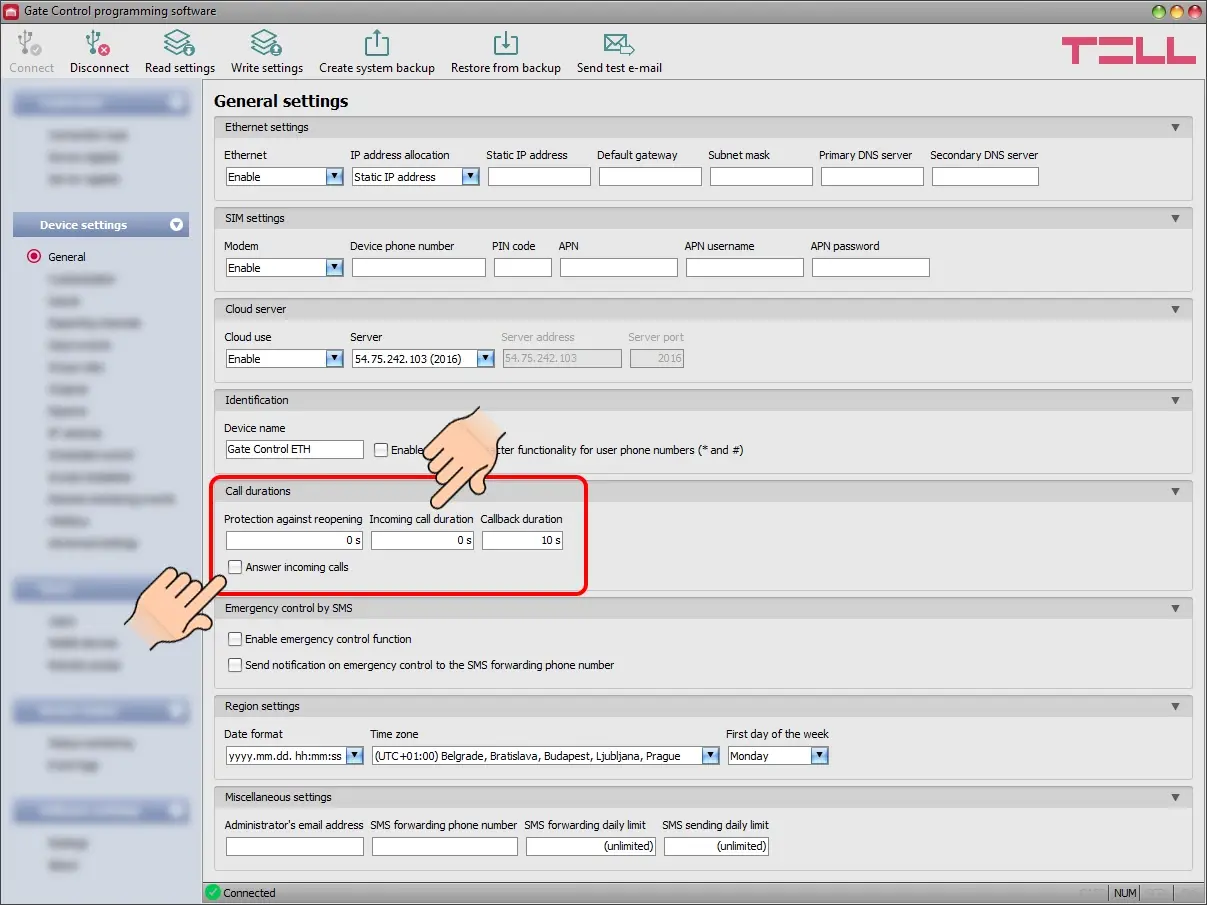
As a result, the call is no longer perceived by the mobile network as an immediately terminated unanswered call. Instead, it appears as a normal answered call.
In other words, the network detects a standard voice call, which is significantly less likely to be affected by filtering mechanisms or abnormal call-handling procedures.
The objective of this feature is clear: to reduce the risks associated with traditional call-rejection operation and provide more reliable phone-based gate opening on networks where the handling of short unanswered calls has become less predictable.
Important: answered calls may generate charges
One important difference should be considered.
When the Accept Incoming Calls feature is enabled, the device actually answers the call. Depending on the caller’s mobile subscription plan, gate opening may therefore incur call charges.
This differs from traditional call-rejection operation, where unanswered calls typically do not generate charges, although this may also vary by operator.
This represents a deliberate trade-off: the user may gain increased reliability in phone-based gate control, while an answered call may result in call costs depending on the mobile tariff plan.
Who should consider enabling this feature?
Users whose traditional automatically rejected call operation remains stable and reliable may not need to make any changes. The feature is entirely optional.
However, if a mobile operator’s network has become less reliable in handling short unanswered calls, causing intermittent gate-opening issues, enabling the Accept Incoming Calls feature can provide a significant improvement in operational stability.
The feature requires the latest firmware and programming software versions, which are available by clicking HERE.
Questions? We’re here to help
If you have any questions regarding the operation, configuration, or firmware update required for the Accept Incoming Calls feature, please contact our technical support team.
Our specialists are available on business days between 08:00 and 17:00 (Budapest time):
E-mail: support@tell.hu