
Your cart is empty.
Click here to purchase!
News
Continuous monitoring of RCDs in industrial environments
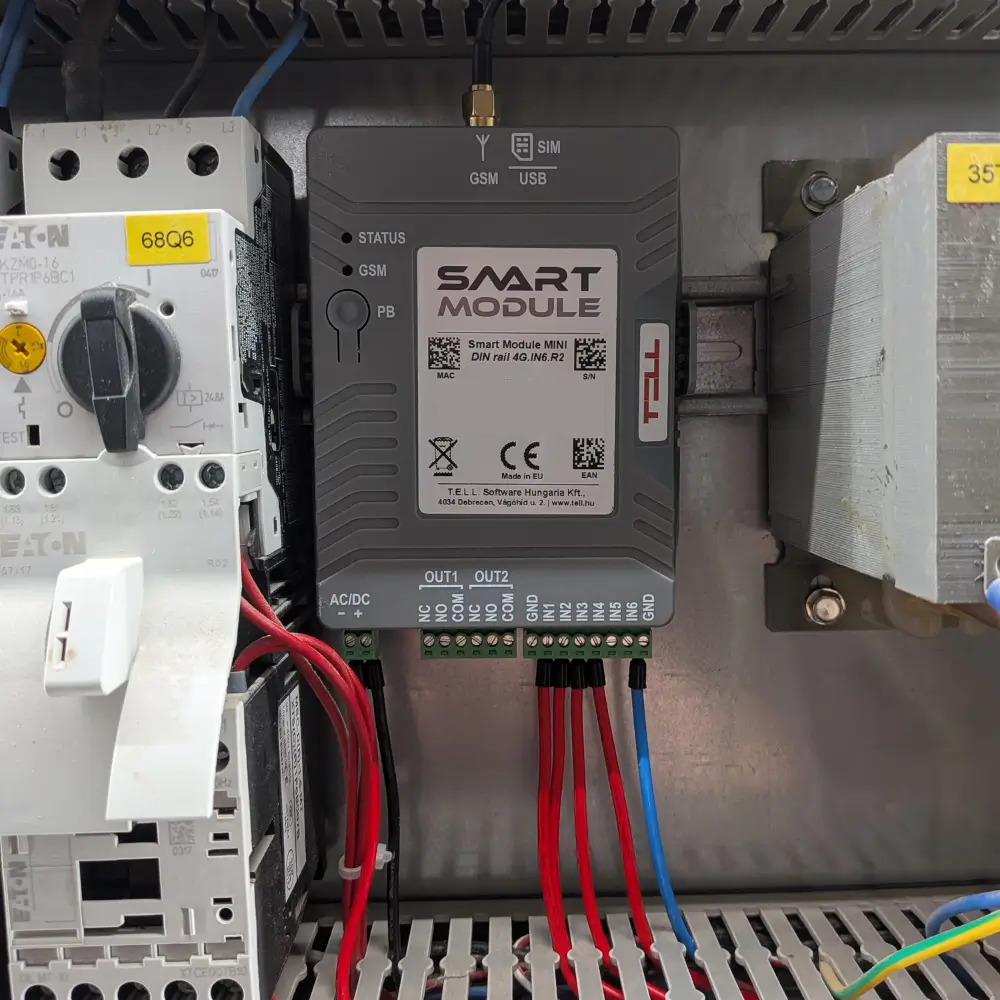
Through a real installation example, we demonstrate how reliable, real-time remote monitoring of RCDs (FI relays) across multiple industrial halls can be achieved using the Smart Module MINI DIN rail.
This case study demonstrates, through a real installation example, how reliable, real-time remote monitoring of RCDs (FI relays) across multiple industrial halls can be achieved using the Smart Module MINI DIN rail device.
The operational reliability of an industrial facility’s electrical network directly impacts production continuity and compliance with safety regulations. RCDs (Residual Current Devices) play a critical role in electrical protection; however, their status is traditionally only verified through on-site inspections.
In facilities consisting of multiple halls, this represents a significant operational burden and risk, especially if a trip event is detected with delay. The objective of this project was therefore to develop a remote monitoring solution capable of providing real-time feedback on the status of protection circuits and delivering immediate notifications of relevant events.
The technical implementation presented in this case study was shared by Attila Vojnár and is particularly valuable as it is based on real-world installation experience and practical operation. Such feedback significantly contributes to system development and partner support.
Challenge
In the electrical networks of multiple industrial halls, continuous monitoring of RCD status was essential. Failures or trips of such protective devices may result not only in downtime but also in safety risks.
The main challenge was to reliably monitor multiple protection circuits (typically 4–6 per building) in real time, while ensuring system operability even in the event of a power outage.
The solution utilized the Smart Module MINI DIN rail device, enabling continuous monitoring of input signals and immediate event transmission via multiple notification channels.
Additionally, the user required a customized notification logic capable of delivering alerts via voice calls, email, and SMS.
Objective
The goal was to develop a stable, scalable, and reliable monitoring system that:
- continuously monitors RCDs across multiple halls
- provides immediate alerts in case of faults or trips
- supports customized notification logic (voice call, email, SMS)
- remains operational during power outages using an external battery
- ensures clear event identification using zone-based labeling
The system architecture is based on connecting outgoing RCD circuits through Schneider 6A miniature circuit breakers to Finder auxiliary relays, whose states are monitored by the Smart Module MINI inputs.
Result
The implemented system provides stable and reliable operation, even when monitoring multiple buildings simultaneously.
During deployment, an important configuration insight emerged: the correct sequence of setup steps is critical for proper system operation.
The optimal configuration process is as follows:
- Upload custom audio files (8 kHz, mono WAV format)
- Configure input events: zone naming (e.g. Clima 1, Alumbrado); assign notifications (voice, email, SMS)
- Set input parameters: Normally Closed (NC) mode; 2-second sensitivity
- Configure notification channels: define phone numbers and email addresses
If this sequence is not followed, the system may delete or ignore custom audio files, resulting in operational inconsistencies.
When configured correctly, the system becomes fully stable and all notification functions operate reliably.
Feedback
Based on user experience, the system is stable, scalable, and reliable in its current form.
Following fine-tuning of the configuration process, the modules operate consistently, and notifications are accurate and dependable.
It is worth highlighting that the detailed feedback and shared experience of Attila Vojnár provide valuable guidance for other installers and partners, offering practical, field-tested insights into effective system deployment.
The flexibility of the solution is demonstrated by future expansion plans, including output control and more complex automation logic, ensuring long-term value.